




p (1).png)




.png)




.png)

Case Study
Presumed Agent Orange Exposure in Vietnam Veterans is Associated with Lower Urinary Tract Symptoms
- Dr. Steven C. Castle
Corresponding author: Dr. Steven C. Castle, Geriatric Research Education and Clinical Center (GRECC), VA Greater Los Angeles; Department of Medicine, UCLA School of Medicine.
Volume: 3
Issue: 1
Article Information
Article Type : Case Study
Citation : Steven C. Castle, Abigail Viado, Frank Catapano, Cathy C. Lee. Presumed Agent Orange Exposure in Vietnam Veterans is Associated with Lower Urinary Tract Symptoms. Journal of Medical and Clinical Case Reports 3(1). https://doi.org/10.61615/JMCCR/2026/JAN027140121
Copyright: © 2026 Steven C. Castle. This is an open-access article distributed under the terms of the Creative Commons Attribution License, which permits unrestricted use, distribution, and reproduction in any medium, provided the original author and source are credited.
DOI: https://doi.org/10.61615/JMCCR/2026/JAN027140121
Publication History
Received Date
30 Dec ,2025
Accepted Date
13 Jan ,2026
Published Date
21 Jan ,2026
Abstract
Background
As part of a clinical innovation project to look at the impact of presumed Agent Orange Exposure (AOE) in Vietnam Veterans, we enrolled Vietnam Veterans in the Gerofit Group Exercise Program and assessed their fitness and cognition. To look into the potential of a Veteran having presumed AOE, we used qualitative and quantitative screening methods described below.
Case Presentation
We incidentally observed that the AOE Veterans had active bladder symptoms (Lower Urinary Tract Symptoms or LUTS). A literature review failed to identify any human studies, but we did find 3 mouse model studies that supported the idea that AO or Dioxin exposure to mice in utero or during lactation resulted in active bladder issues when the mice became older due to enhanced neuromodulation of the bladder from the dioxin. So, we used the Lower Urinary Tract Dysfunction Symptom Index-10 (LURN SI-10) to measure the severity of LUTS and compared those with presumed and without presumed AOE.
Conclusion
Presumed AOE Veterans had significantly higher LURN SI-10 scores, and this supports the conclusion that Veterans presumed to be exposed to Agent Orange are more prone to bladder issues.
►Presumed Agent Orange Exposure in Vietnam Veterans is Associated with Lower Urinary Tract Symptoms
Steven C. Castle1*, Abigail Viado2, Frank Catapano3, Cathy C. Lee4
1,2,3,4Geriatric Research Education and Clinical Center (GRECC), VA Greater Los Angeles; Department of Medicine, UCLA School of Medicine.
Introduction
We are conducting a study to look at the possible impact of presumed Agent Orange Exposure (AOE) on mobility and balance. This was part of an ongoing Clinical Innovations Project funded by the National Office of Geriatrics and Extended Care of the Veterans Health Administration, initially funded in 2023. Presumably, 2.7 million US Military may have been exposed to AO between 1962 -71 [2]. It is estimated that over 300,000 US Veterans and over 400,000 Vietnamese died from AOE between 1962 and 1971. The US sprayed 20 times more AO than the manufacturer recommended. AO is 2,3,7,8- tetrachlorodibenzo-p-dioxin (TCDD or Dioxin) and persists in humans for a half-life of 7-11 years and persists indefinitely in the environment. “The Vietnamese Red Cross estimates that 3 million Vietnamese have been affected by dioxin, including at least 150,000 children born after the war with serious birth defects” (Wells-Dang A, usip.org/publications). Presumptive conditions of AOE have demonstrated an increase in healthcare utilization, and the PACT Act was passed in August 2022 to expand healthcare and benefits to Veterans with presumed toxic exposures like burn pits or AO. Presumptive conditions from AOE are listed on this website: https://www.pendercountync.gov/va/agent-orange-presumptive-conditions/ , and we intend to look further into possible impact on cognition and mobility. This project and Gerofit are quality improvement/quality assurance projects and approved by the institutional review board at the VA Greater Los Angeles Healthcare System, and participants are not required to sign consents.
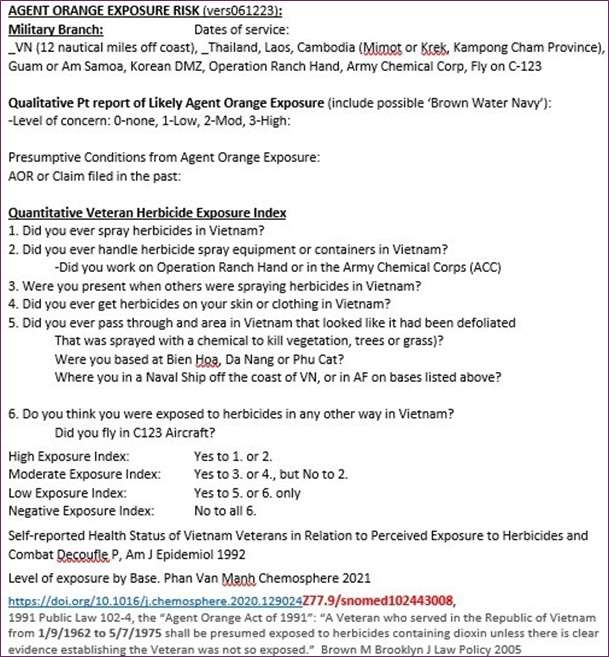
In a literature search and discussion with national experts to detect presumed AOE, we came up with a Qualitative (Does Veteran have no, minor, moderate, or significant concern) and a Quantitative Veteran Herbicide Exposure Index based on 6 questions that rate their presumed exposure risk as negative, low, moderate, or high ([3], see Figure 1).
Figure: 1
We widely distributed brochures about this program with the intention of enrolling Vietnam Veterans in our Gerofit Exercise program [4], provided seminars to Veterans Service Organizations and primary care providers at our VA Facility to engage with Veterans with presumed exposure to AO, with the goal of enrolling them into Gerofit. For those identified with presumed AOE, we facilitated filing Claims with the Veterans Benefits Administration if they had not previously filed a claim and wanted to.
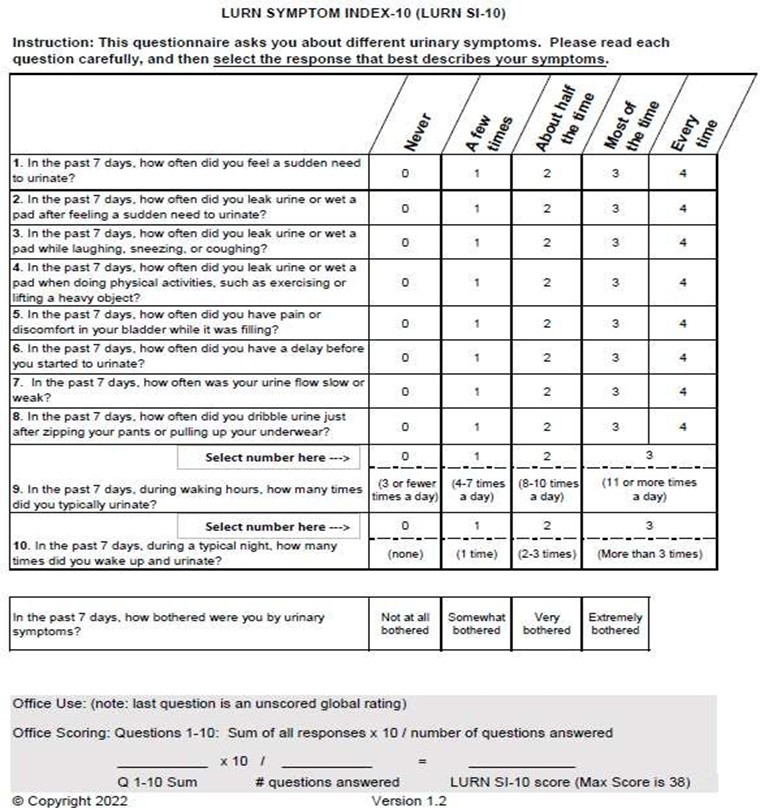
As we began to accumulate presumed AOE Veterans, it was subjectively noticed that presumed AOE Veterans had active bladder symptoms, or Lower Urinary Tract Symptoms (LUTS). A literature search did not identify any human studies or reports, but we found 3 rodent studies in which TCDD exposure occurred In Utero and/or during lactation to the mother, resulting in dysfunction of the lower urinary tract in adulthood. The bladders of the exposed mice were significantly heavier, and urodynamic voiding behavior showed a marked reduction in intervoid interval. It was found that the TCDD exposure resulted in enhanced recruitment of noradrenergic neurons with a permanent increase in noradrenergic axon density and excessive prostatic and urethral smooth muscle tone [5]. In speaking to some experts in LUTS, the Lower Urinary Tract Dysfunction Research Network developed the Symptom Index-10 (LURN SI-10), with a max score of 38, which was felt to be the best screening method for LUTS (Cella D Neurourology & Urodynamics 2019, see Figure 2). This was given to the Veterans. We compared the LURN SI-10 scores of three comparison groups:
- Negative Presumed AOE: Qualitative and Quantitative scores=0
- Presumed AOE:
- Qualitative AND Quantitative AOE risk questionnaires both >0,
- Qualitative OR Quantitative >0
Figure: 2
Results
A total of 25 Vietnam Veterans were surveyed with the LURN SI-10. Twelve had Qualitative and Quantitative Presumed AOE of 0 with a mean age of 82.0+7.9 years, range 68-95, versus 15 Veterans with some presumed AOE (Qualitative OR Quantitative > 0) with a mean age of 76.9 + 4.4 years, range 74-91 (p not significant). Comparison of the LUTS scores was statistically analyzed using Excel, and values of p <0.05 were considered statistically significant.
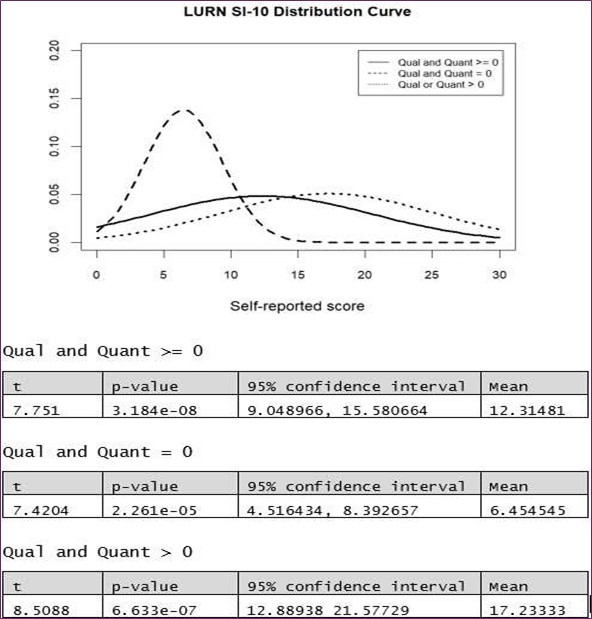
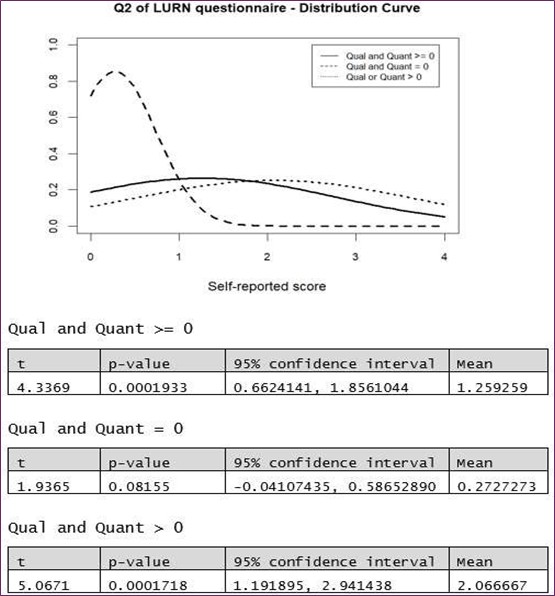
There were statistically significantly lower LURN SI-10 scores in Veterans with negative Qualitative AND Quantitative AOE risk (see figures 3 & 4) versus Veterans with presumed risk of AOE. We also compared the same exposure categories to the specific response scores on the 1st two questions that reflect LUTS related to an Overactive Bladder (OAB).
Question 1: In the past 7 days, how often did you feel the sudden need to urinate, and
Question 2: In the past 7 days, how often did you leak urine or wet a pad while laughing, sneezing, or coughing.
Figure:3
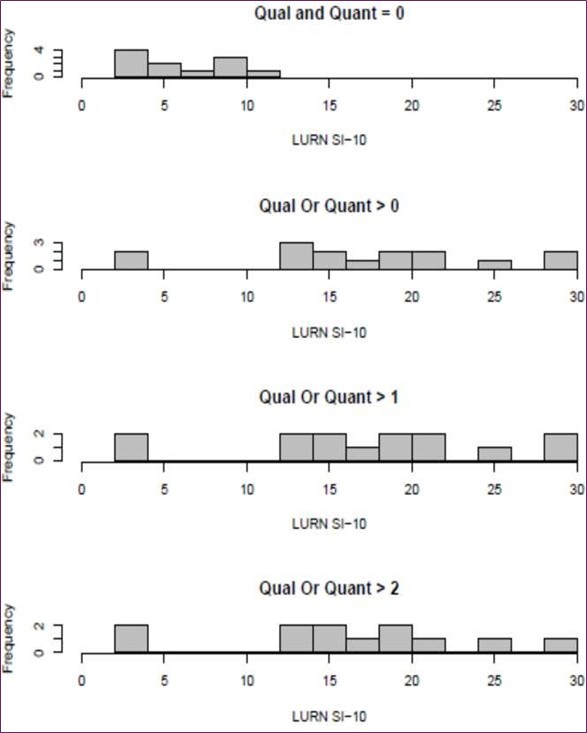
Figure: 4
We found significantly lower scores in the Qualitative AND Quantitative presumed negative exposure group versus any presumed exposure (See figures 5-6).
Ethics-Gerofit studies are reviewed and approved by the VA Greater Los Angele IRB as QI/QA projects.
Figure: 5
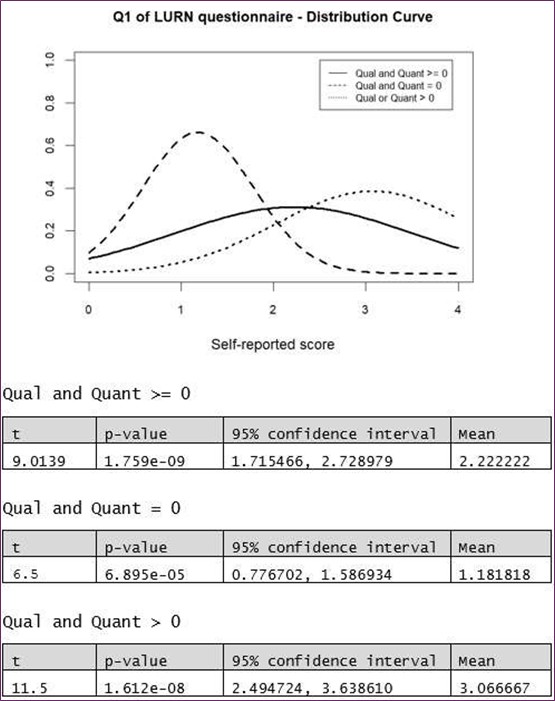
Figure: 6
Conclusion
The conclusion is that presumed AOE/Dioxin Exposure of Veterans is having a lasting impact on LUTS with what appears to be OAB. What we plan to do next is first teach the Veterans' pelvic floor strengthening exercise, and if LURN SI-10 does not improve, then a referral to Urology for a possible medication trial.
- VA website of presumptive conditions related to Agent Orange Exposure, and we intend to look.
- Fried DA, Rajan M, Tseng HL, Helmer D. (2018). Impact of presumed service-connection diagnosis on the Department of Veterans Affairs healthcare utilization patterns of Vietnam-theater Veterans. Medicine. 97(19): 0662.
- Decoufle P, Holmgren P, Boyle CA, Stroup NE. (1992). Self-reported health status of Vietnam Veterans in relation to perceived exposure to herbicides and combat. Am J Epidemiology. 135(3): 312-323.
- Manning KM, Hall KS, Sloane R, Magistro D, Ragalietti E, Lee CL, Castle S, Kopp T, Giffuni J, Katzel L, McDonald M, Miyamoto M, Pearson M, Jennings SC, Bettger JP, Morey MC. (2023). Longitudinal analysis of physical function in older adults: The effects of physical inactivity and exercise training. Aging Cell. 23(1): 13987.
- Ricke WA, Lee CW, Clapper TR, Schneider AJ, Moore RW, Keil KP, Abler LL, Wynder JL, Alvarado AL, Beaubrun I, Vo J, Bauman TM, Ricke EA, Petereson RE, Vezina CM. (2016). In utero and Lactational TCDD exposure increases susceptibility to lower urinary tract dysfunction in adulthood. Society of Toxicology. 150(2): 429-440.
- Turco AE, Oakes RO, Keil Stietz KP, Dunham CL, Joseph DB, Chathurvedula TS, Girardi NM, Schneider AJ, Gawdzik J, Sheftel CM, Wang P, Bjorling DE, Ricke WA, Tang W, Hernandez LL, Keast JR, Bonev AD, Grimes MD, Strand DW, Tykocki NR, Tanguay RL, Peterson RE, Vezina CM. (2021). A mechanism linking Perinatal 2,3,7,8 tetrachlorodibenzo-p-dioxin exposure to lower urinary tract dysfunction in adulthood. Disease Models & Mechanisms. 14(7): 049068.
- Dang-Wells A. United States Institute of Peace.
- Cella D, Smith AR, Griffith JW, Kirkali Z, Flynn KE, Bradley CS, Jelovsek JE, Gillespie BW, Helfand BT, Talaty P, Weinfurt KP. (2020). A new brief clinical assessment of lower urinary tract symptoms for women and men. LURN SI- 10, J Urology. 203(1): 164-170.
Download Provisional PDF Here
PDF